

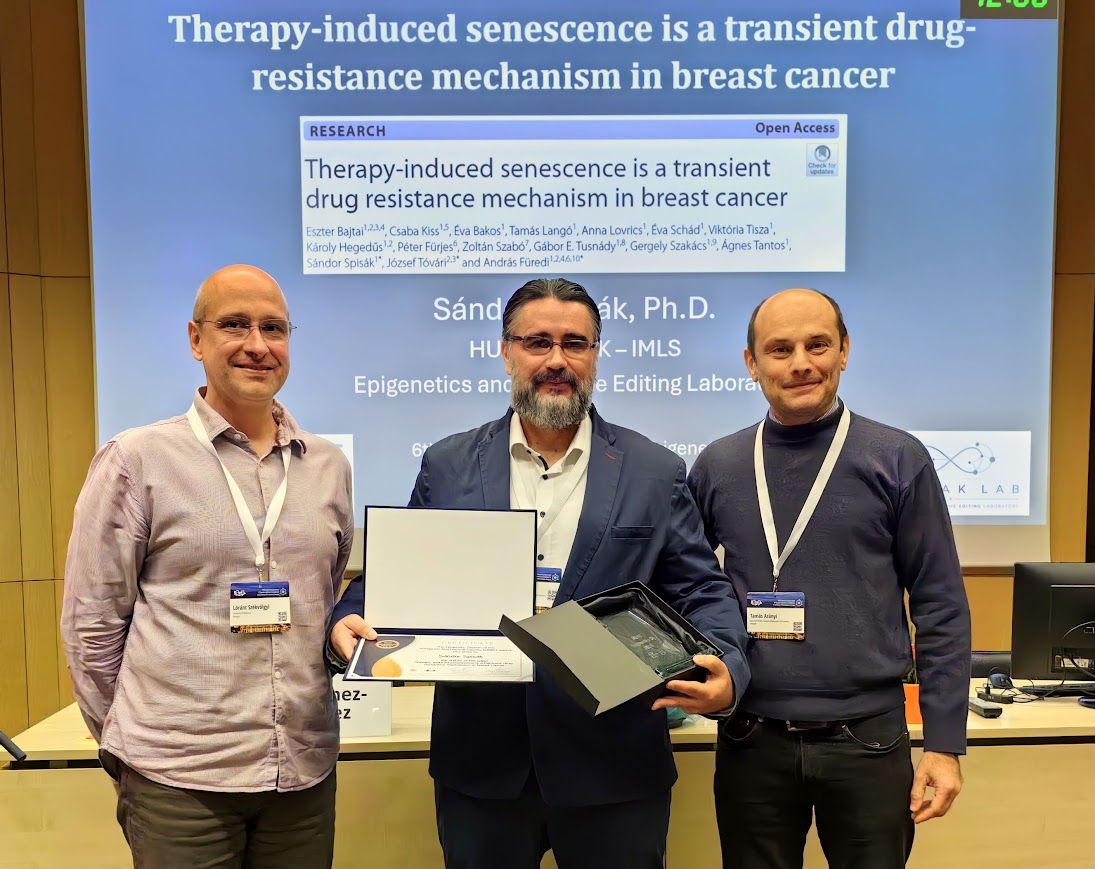
Sándor Spisák, head of the Epigenetics and Genome Editing Research Group at the Institute of Molecular Life Sciences, HUN-REN Research Centre for Natural Sciences, has been awarded the Epigenetics Prize of the Hungarian Biochemical Society (MBKE). The prize was presented at the 6th Danube Conference on Epigenetics, a FEBS Advanced Lecture Course held in Budapest from 19 to 22 October 2026.
The group studies how chromatin structure and cellular metabolism govern transitions between tumour cell states, and how the state a tumour cell occupies at the time of treatment shapes the outcome of therapy. The work relies on endogenous cell-state reporter systems, single-cell multiome profiling and CRISPR screens in tumour models.
This interest in the chromatin-level control of therapy response links the group to the collaborative study led by András Füredi and the Drug Resistance Research Group at HUN-REN RCNS, which formed the basis of the prize lecture. In the resulting paper, published in Molecular Cancer with Eszter Bajtai as first author, the group carried out the single-cell transcriptomic analysis.
The study showed that therapy-induced senescence in the breast cancer models examined is a transient and reversible state that can be induced repeatedly. Cells in this state arrest division and become tolerant to a range of anticancer agents, yet they can resume proliferation later. The research groups of Ágnes Tantos and Gábor Tusnády, together with the group led by József Tóvári at the National Institute of Oncology, also contributed to the work.
The lecture presented these findings from the perspective of the chromatin landscape underlying cell-state transitions, extended with previously unpublished data. It also featured the study by Laura Vízkeleti and colleagues, released as a bioRxiv preprint, which examines in colorectal cancer models how folate availability shapes tumour cell state and chemosensitivity through epigenetic regulation.
Our warmest congratulations on this recognition.
Related publications
Bajtai E., Kiss C., Bakos É. et al. Therapy-induced senescence is a transient drug resistance mechanism in breast cancer. Molecular Cancer 24, 128 (2025). https://doi.org/10.1186/s12943-025-02310-0
Vízkeleti L. et al. bioRxiv (2026), preprint. https://doi.org/10.64898/2026.09.30.755690